Banquet & Table Linen Procurement: What Every Hotel Buyer Should Know
Published by Galaxy Hotel Supplies | For Hotel Procurement Managers
Banquet and table linen is one of the most visible — and most demanding — procurement categories in hotel operations. At a gala dinner, a wedding reception, or a corporate conference, table linen is a primary design element. It sets the visual tone of the event, reinforces the property’s brand positioning, and contributes directly to how guests experience the occasion.
Yet table linen procurement is consistently underestimated. Many hotel buyers treat it as a commodity purchase — focusing on price per metre and stock availability — without understanding the technical specifications that determine whether linen will perform, look professional, and survive the rigours of high-volume banquet operations.
This guide gives hotel procurement managers a complete framework for banquet and table linen procurement: fabric selection, sizing standards, construction quality, colour and finish considerations, supplier evaluation, and the operational factors that separate reliable performance from costly disappointment.
1. Why Banquet Linen Procurement Is Different
Banquet and table linen operates under fundamentally different conditions from guest room linen:
Visual scrutiny is higher. Table linen is examined at close range by seated guests throughout an event. Inconsistencies in colour, weave, or finish that might pass unnoticed in a guest room are immediately visible across a banqueted table.
Event scheduling creates pressure. Banquet linen must be laundered, pressed, and ready on a precise schedule — often with very short turnaround between events. Operational reliability is as important as product quality.
Staining is intensive. Food, wine, sauces, and candle wax are common contaminants. Table linen must resist staining effectively, release stains under industrial laundering, and maintain appearance across hundreds of wash cycles.
Sizing complexity is greater. Tablecloths must fit specific table dimensions precisely — too small and the drape is inadequate; too large and the linen pools on the floor. Napkins, overlays, runners, and skirting all have distinct size requirements. Managing this complexity across a large banquet inventory requires careful specification and supplier discipline.
Volume fluctuates significantly. A hotel with a 500-seat ballroom may require thousands of pieces for a single event — and need them all available simultaneously. Par level calculations for banquet linen must account for peak demand, not average demand.
2. Fabric Options for Table Linen
Fabric choice determines appearance, durability, laundry performance, and cost. The right choice depends on your property tier, event type mix, and operational requirements.
Polyester (100% or Polyester-Dominant Blend)
The most widely used fabric in hotel banquet operations globally. Polyester table linen offers a compelling combination of durability, wrinkle resistance, and cost-effectiveness that makes it the practical choice for high-volume operations.
Advantages:
- Excellent wrinkle resistance — critical for table linen that must look pressed throughout a long event
- High durability under industrial laundering at high temperatures
- Good stain release performance, particularly with food and beverage stains
- Colour fastness — polyester holds dye exceptionally well, maintaining colour consistency across hundreds of wash cycles
- Lower cost per unit and per use than natural fibre alternatives
Disadvantages:
- Less premium in appearance and hand feel than natural fibres
- Can appear synthetic under certain lighting conditions
- Not appropriate for ultra-luxury positioning
Recommended for: Mid-market, upscale, and conference-focused properties; high-volume banquet operations; any property where operational practicality is the primary driver.
GSM recommendation: 160–220 GSM for tablecloths; 180–250 GSM for napkins (heavier napkin weight improves drape and perceived quality).
Cotton-Polyester Blend (65/35 or 50/50)
Combines the natural feel and appearance of cotton with the durability and wrinkle resistance of polyester. A strong choice for properties seeking a balance between quality appearance and operational performance.
Advantages:
- More natural appearance and hand feel than 100% polyester
- Better breathability than pure polyester
- Good durability under industrial laundering
- More forgiving of minor laundering variations than 100% cotton
Disadvantages:
- More prone to wrinkling than 100% polyester
- Requires careful temperature management in laundering and ironing
- Higher cost than polyester
Recommended for: Upscale and upper-midscale properties; properties with a mixed event profile (corporate and social events).
100% Cotton (Damask or Plain Weave)
The traditional premium choice for fine dining and formal banquet settings. Cotton table linen delivers a natural drape, a luxurious hand feel, and a classic aesthetic that polyester cannot fully replicate.
Advantages:
- Premium appearance and drape — the benchmark for luxury banquet settings
- Natural fibre feel that guests associate with quality
- Damask weave patterns (woven-in designs) are distinctive and elegant
- Improves in softness with laundering over time
Disadvantages:
- Wrinkles readily — requires immediate calendering after laundering; cannot be left to sit damp
- Less forgiving of laundering errors — temperature variation, over-drying, and incorrect pressing can cause permanent damage
- Higher cost per unit
- Shorter wash cycle lifespan than polyester equivalents under aggressive industrial laundering
Recommended for: Luxury and ultra-luxury properties; fine dining restaurants; formal banquet settings where appearance is the primary consideration and operational resources support careful linen care.
Linen (Flax)
Natural linen (flax fibre) offers a distinctive textured appearance increasingly popular in boutique, lifestyle, and farm-to-table F&B settings.
Advantages:
- Distinctive natural texture that communicates authenticity and craft
- Strong sustainability credentials (flax requires minimal water and pesticides)
- Naturally antibacterial
- Improves in softness with use and washing
Disadvantages:
- Expensive — significantly higher cost than cotton or polyester
- Wrinkles heavily and must be embraced as part of the aesthetic, or carefully managed with immediate pressing
- Requires specialist laundering care
- Limited colour range compared to dyed polyester or cotton
Recommended for: Boutique hotels, lifestyle properties, farm-to-table restaurants, and any setting where a deliberately natural, textured aesthetic is part of the brand identity.
Specialty and Decorative Fabrics
For overlay cloths, chair covers, table runners, and skirting, a broader range of decorative fabrics is commonly used:
- Satin and taffeta: High sheen, formal settings, weddings and gala events
- Velvet: Ultra-luxury events, winter and festive settings
- Organza: Overlay cloths for weddings and high-end social events
- Jacquard weave: Woven patterns for formal dining and branded banquet settings
- Spandex/stretch: Form-fitting chair covers and cocktail table covers; highly practical for consistent fit
3. Fabric Performance Standards
For any table linen fabric, request third-party test data for the following performance criteria:
| Test | Standard | Why It Matters |
|---|---|---|
| Colorfastness to washing | AATCC 61 / ISO 105-C06 | Prevents fading and dye transfer in laundering |
| Colorfastness to light | AATCC 16 / ISO 105-B02 | Prevents fading in lit event environments |
| Colorfastness to rubbing | AATCC 8 / ISO 105-X12 | Prevents colour transfer to guest clothing |
| Dimensional stability (shrinkage) | AATCC 135 / ISO 6330 | Critical for maintaining precise table fit |
| Pilling resistance | ASTM D3512 / ISO 12945 | Maintains professional appearance over service life |
| Stain release | AATCC 130 | Confirms effective stain removal under laundering |
| Wrinkle recovery | AATCC 66 / ISO 2313 | Relevant for cotton and blended fabrics |
Shrinkage is particularly critical for table linen. A tablecloth that shrinks by 5% after washing will no longer fit the table it was specified for — creating operational problems and additional procurement cost. Require shrinkage tolerance of ≤2% and confirm in writing.
4. Sizing Standards — Getting the Specification Right
Incorrect sizing is one of the most common and most costly errors in table linen procurement. Every tablecloth must be specified against the exact table dimensions it will cover, with the correct drop length.
Standard Table Dimensions
Confirm your property’s actual table dimensions before ordering — industry standard sizes vary by market and manufacturer:
| Table Shape | Common Sizes |
|---|---|
| Round | 150cm, 180cm, 200cm diameter |
| Rectangular | 180×90cm, 240×90cm, 300×90cm |
| Square | 90×90cm, 120×120cm |
| Cocktail (poseur) | 60cm diameter, 80cm diameter |
Drop Length
The drop is the amount of tablecloth that hangs over the edge of the table on each side. Standard drop lengths:
| Setting | Drop Length | Notes |
|---|---|---|
| Formal banquet | 30–40cm | Full drape to below guest knee level |
| Casual dining | 20–25cm | Practical; allows guest seating access |
| Floor-length | To floor | Buffet tables, display tables, high-end galas |
| Cocktail cover | Full cover to floor | Poseur/cocktail tables |
Tablecloth size formula:
Tablecloth length = Table length + (drop × 2) Tablecloth width = Table width + (drop × 2)
Example: A 180×90cm rectangular table with a 30cm drop requires a tablecloth of 240×150cm.
Napkin Sizing
| Setting | Napkin Size |
|---|---|
| Formal dinner | 55×55cm or 60×60cm |
| Casual dining | 45×45cm or 50×50cm |
| Cocktail / café | 30×30cm or 40×40cm |
| Buffet | 40×40cm |
Runner and Overlay Sizing
- Table runner width: Typically 30–45cm; length to suit table with 20–30cm drop at each end
- Overlay cloth: Typically 85×85cm or 90×90cm for a 180cm round table; creates a layered look over a base cloth
5. Construction and Finishing Quality
Premium fabric with poor construction will fail prematurely in a demanding banquet environment. Inspect these details on every sample:
Hem and Edge Finishing
- Mitered corners: The industry standard for quality table linen. Corners should be neatly folded at 45° and stitched flat — no bunching, puckering, or uneven angles
- Hem width: 1–2cm hemmed border is standard; wider hems add weight and visual quality
- Stitch density: 10–14 stitches per inch; fewer stitches unravel under industrial washing and repeated folding
- Double-stitched hems: Mandatory for table linen subjected to high-frequency laundering
- Overlock finishing on raw edges: Prevents fraying during laundering; inspect that overlock stitching is tight and even
Weave and Surface Quality
- Hold the fabric up to light and inspect for weave irregularities, dropped threads, or inconsistent density
- Run a hand firmly across the surface — a quality fabric should feel smooth and consistent, with no rough patches or loose threads
- For white linen, inspect for optical brightening agent (OBA) use — OBAs cause yellowing after repeated industrial washing with chlorine-based products
Labelling
- Size labels should be clearly marked on every item — critical for inventory management in large banquet operations
- Wash care labels must be accurate and durable — incorrect care instructions followed by laundry staff cause preventable damage
6. Colour and Finish Considerations
White Linen
White remains the dominant choice for formal banquet and fine dining settings. It communicates cleanliness, formality, and quality — and allows the greatest flexibility for event décor.
Procurement considerations for white linen:
- Specify the degree of whiteness required — optical white (bright, blue-toned) vs. natural white (warmer, ivory-toned)
- Confirm whether OBAs are used and at what concentration — OBAs degrade with chlorine bleach laundering, causing yellowing over time
- Request whiteness retention data after 50 and 100 wash cycles
Coloured and Patterned Linen
For properties with strong brand colours, seasonal event programmes, or lifestyle F&B concepts, coloured and patterned linen adds visual identity and event flexibility.
Key colorfastness requirements:
- Specify Pantone colour references for all coloured linen — verbal colour descriptions are insufficient for consistent reorders
- Require AATCC 61 colorfastness to washing (minimum Grade 4 rating)
- Request a colour sample from the bulk production run before accepting delivery — colour variation between production runs is common with dyed fabrics
Damask Patterns
Woven damask patterns (typically floral, geometric, or heraldic motifs) add visual richness to formal dining settings without the maintenance complexity of printed designs. The pattern is woven into the fabric structure — not printed — and does not fade or crack with laundering.
7. Operational Considerations for Banquet Linen
Turnaround Time Planning
High-volume banquet operations often run multiple events in a single day — requiring the same linen to be collected, laundered, pressed, and redeployed within hours.
Key questions for your laundry operation:
- What is the minimum turnaround time from collection to re-deployment?
- What is the laundry capacity at peak event schedule?
- Is flatwork ironer capacity sufficient for the volume of table linen being processed?
Implication for par level: If your property runs back-to-back banquet events with a 4-hour turnaround, you may need 2–3 full sets of linen for peak event days. Calculate par level based on maximum simultaneous event demand, not average daily consumption.
Folding and Storage Standards
Table linen is highly susceptible to fold line damage — permanent creasing that becomes visible on the table and does not press out. Prevent fold line damage through:
- Rolling table linen on cardboard tubes rather than folding where storage space allows
- Using consistent fold patterns that do not place fold lines in visible positions when the cloth is laid
- Storing linen in a dry, temperature-stable environment away from direct sunlight
Event Setup Efficiency
Table linen specification affects event setup speed — a practical consideration that is often overlooked in procurement:
- Consistent, accurate sizing reduces setup time by eliminating adjustment and repositioning
- Colour-coded storage or labelling by table size allows housekeeping and banquet teams to pull the correct linen quickly
- Stretch cocktail covers require no adjustment; traditional drape cloths require positioning care
8. Supplier Evaluation Checklist
- [ ] Can they supply the full size range required for your table inventory, including custom sizes?
- [ ] Do they offer Pantone colour matching for coloured linen orders?
- [ ] Can they provide fabric performance test reports (shrinkage, colorfastness, stain release) from accredited laboratories?
- [ ] What is their production tolerance on dimensions — and can they guarantee ±1cm accuracy on tablecloth sizes?
- [ ] What is their MOQ per size and colour, and can they supply consistent colour across multiple reorder cycles?
- [ ] Do they hold OEKO-TEX® Standard 100 certification?
- [ ] What is their lead time for first orders and repeat orders?
- [ ] Can they provide OEM options — woven labels, custom patterns, branded finishing?
- [ ] Do they have experience supplying comparable hotel banquet operations?
- [ ] What is their policy on dimensional variance and colour inconsistency claims?
9. Pre-Order Protocol
- Measure all tables — confirm exact table dimensions across your full inventory before specifying any tablecloth sizes
- Calculate drop requirements — by event type and setting (formal, casual, floor-length)
- Request physical samples in target fabric, weight, and colour — not just swatches
- Conduct a wash and press test — launder and iron samples under your operation’s conditions; assess shrinkage, colour retention, wrinkle recovery, and stain release
- Check dimensional accuracy — measure samples after washing to confirm shrinkage is within tolerance
- Run an event trial — deploy samples on tables for a live event and assess appearance, drape, and practical performance
- Confirm Pantone references in writing before any coloured linen order
- Pilot order before full commitment — 20–30% of total requirement; assess consistency between pilot and bulk production before committing to the full order
Summary
Banquet and table linen procurement rewards precision. The properties that get it right — specifying the correct fabric for their operational requirements, sizing to exact table dimensions, verifying performance data, and selecting suppliers who deliver consistent quality across repeat orders — create event environments that reflect their brand and support their revenue.
The properties that treat it as a commodity purchase — prioritising unit price over specification accuracy, accepting approximate sizing, and skipping performance verification — face operational disruption, premature replacement, and event quality that falls short of guest expectation.
Apply the framework in this guide to every table linen procurement decision, and the difference will be visible — on every table, at every event.
Galaxy Hotel Supplies manufactures premium banquet and table linen for hotel properties and event venues worldwide — including custom sizing, Pantone colour matching, and woven damask patterns. Contact our team for samples, custom specifications, or a bulk quote.
- #HotelProducts
- #HospitalityTrends
- #HotelBranding
- #B2BHospitality
- #LuxuryHotelBedding
- #CommercialTextiles
- #LuxuryHotels
- #HotelDesign
- #HotelStyle
- #LuxuryTowels
- #HotelRoomDesign
- #HotelManagement
- #PremiumLinens
- #ShowroomTour
- Eliya
- #HotelDecor
- Galaxy
- #GuestSatisfaction
- #HospitalityLinen
- #HospitalityExpo
- #HotelComfort
- #LuxuryHotelSupplies
- #LuxuryLinens
- #HotelIndustry
- #LuxuryHotel
- #HotelAmenities
- #TradeShow
- #HospitalityTextiles
- #HotelTowels
- #HospitalityDesign
- #LuxuryBedding
- #HotelBedding
- #HotelLinens
- #HotelOperations
- #GALAXYHotelSupplies
- #HotelLinen
- #LuxuryHospitality
- #GuestComfort
- #GuestExperience
- #HotelTextiles
- #HotelProcurement
- #HospitalityIndustry
- #HospitalitySupplies
- #HotelSupplies
- #GALAXYHospitality
Hospitality Bedding Wholesale: The Elegance of Jacquard Linens for Hotels
Hospitality Bedding Wholesale: The Elegance of Jacquard Linens for Hotels In the hospitality industry, bedding…
Premium Embroidered Towels for Hotels and Resorts
https://galaxyhotelsupplies.com/wp-content/uploads/2025/09/毛巾三件套刺绣logo语音解说.mp4 In the hospitality industry, details matter—and towels are among the essentials that shape guest…
Inside Our Factory and Showroom: Crafting Five-Star Hotel Linens
Take a virtual tour of our production workshop and textile showroom to see how our…
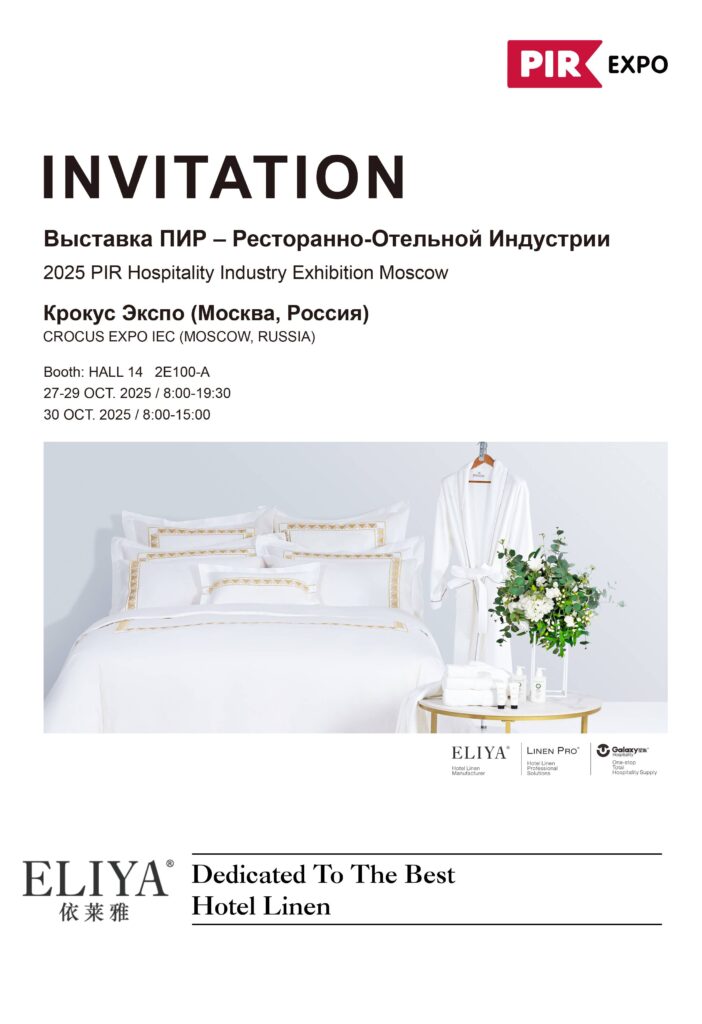
GALAXY HOSPITALITY at Moscow PIR Expo 2025 | Hotel Supplies Showcase
GALAXY HOSPITALITY at PIR Expo Moscow 2025 The hospitality industry is constantly evolving, and international…

Comfort in a Box: Compressed Mattress Unboxing Experience
https://galaxyhotelsupplies.com/wp-content/uploads/2025/08/床垫.mp4 Comfort in a Box: Compressed Mattress Unboxing Experience The hospitality industry is evolving, and…